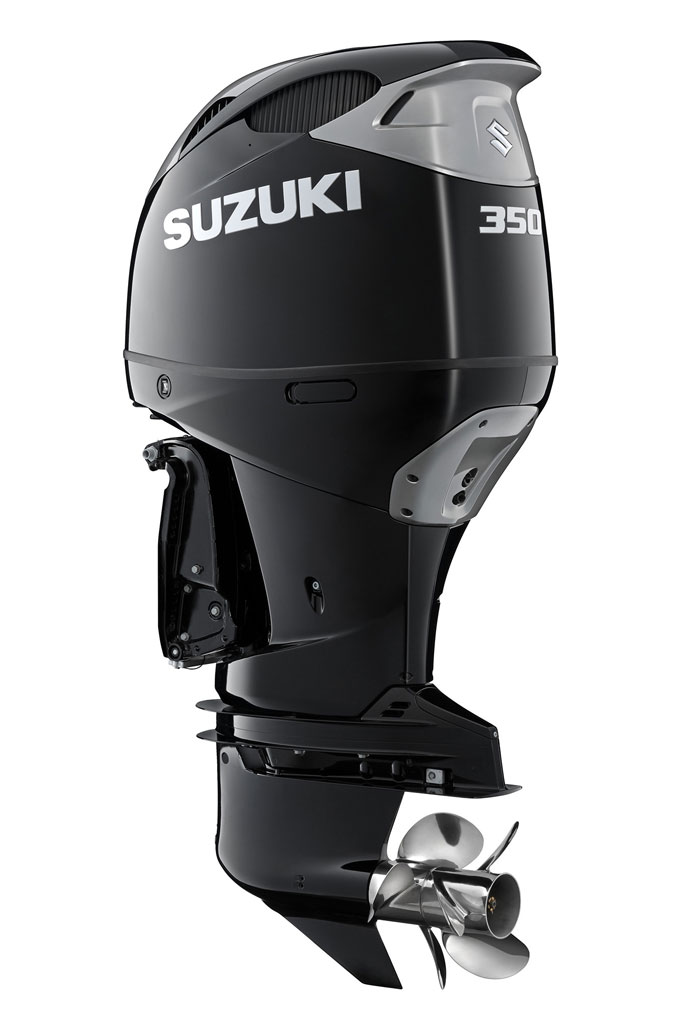

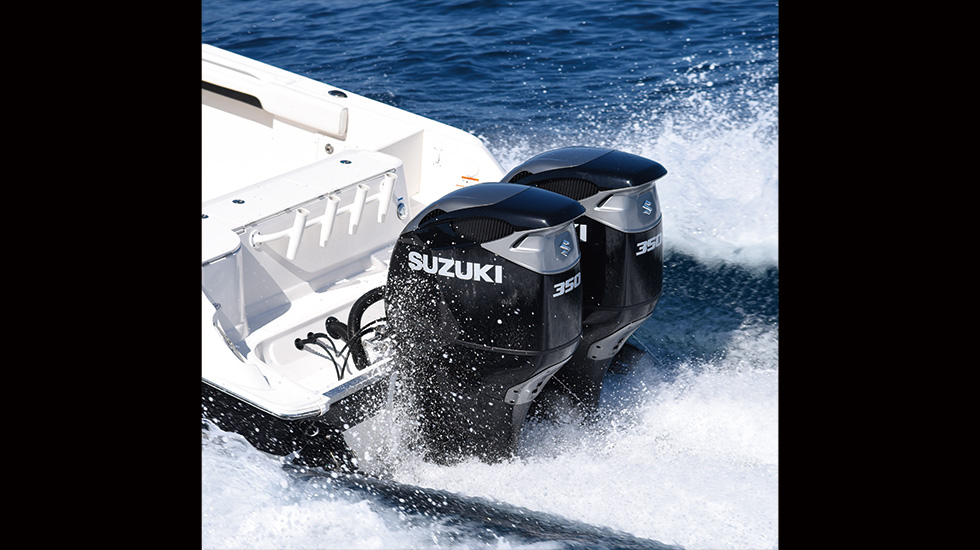
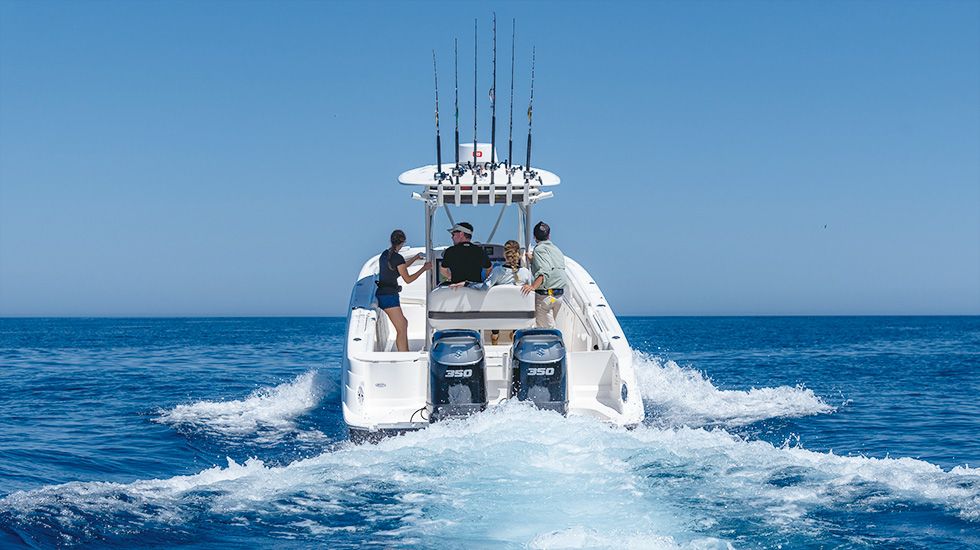
DF350A
HOW THE DF350A CAME TO BE It’s no secret that there is a growing demand for more powerful outboard motors.
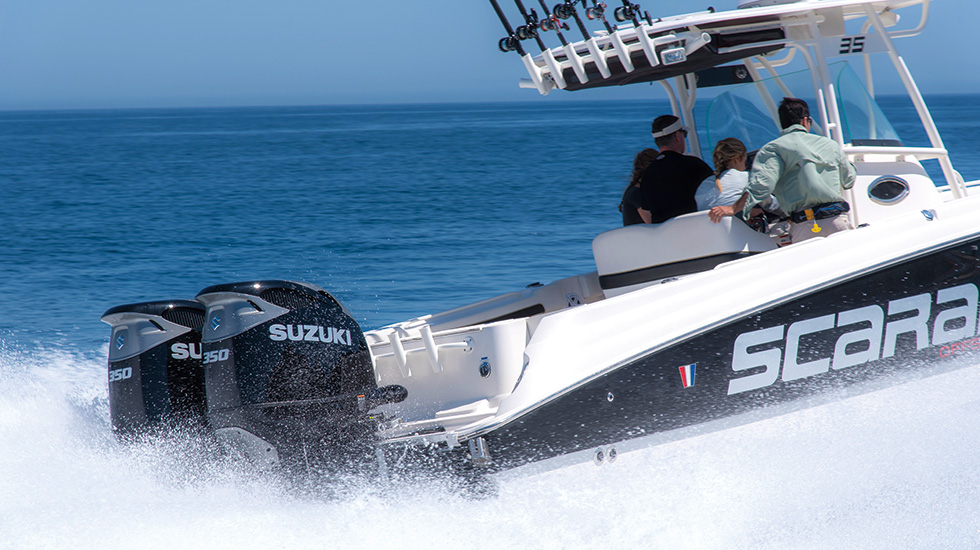
These new outboards have, in turn, fueled a move to newer, larger boat designs that previously may have been powered by stern drive or inboard power.
So, as more powerful outboards are introduced, the boats get bigger and as the boats get bigger, outboards are getting more muscular. Suzuki embarked on a major engineering expedition to build the Ultimate 4-Stroke outboard.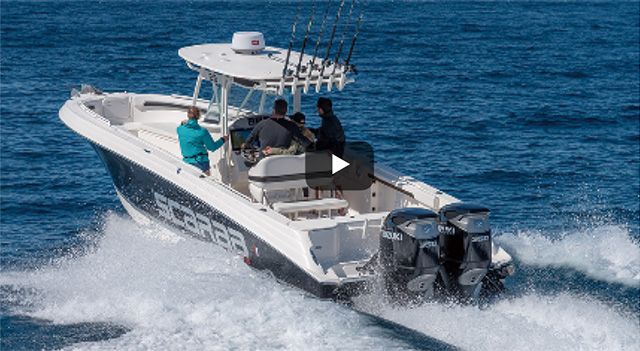
Is The Sky The Limit?
Making more horsepower is no mystery. Increasing displacement, or the use of a turbocharger or supercharger, makes more horsepower. However, larger displacement engines typically burn more fuel, adding weight creates a wide range of problems for boats, and more complex mechanical components create reliability concerns.
On top of all this, boat speed is ultimately limited by hull design, the hydrodynamics of the lower unit and propellers, and how the outboards are mounted.
In developing our new DF350A, we started with a blank sheet of paper, and considered all these factors in our design and engineering.
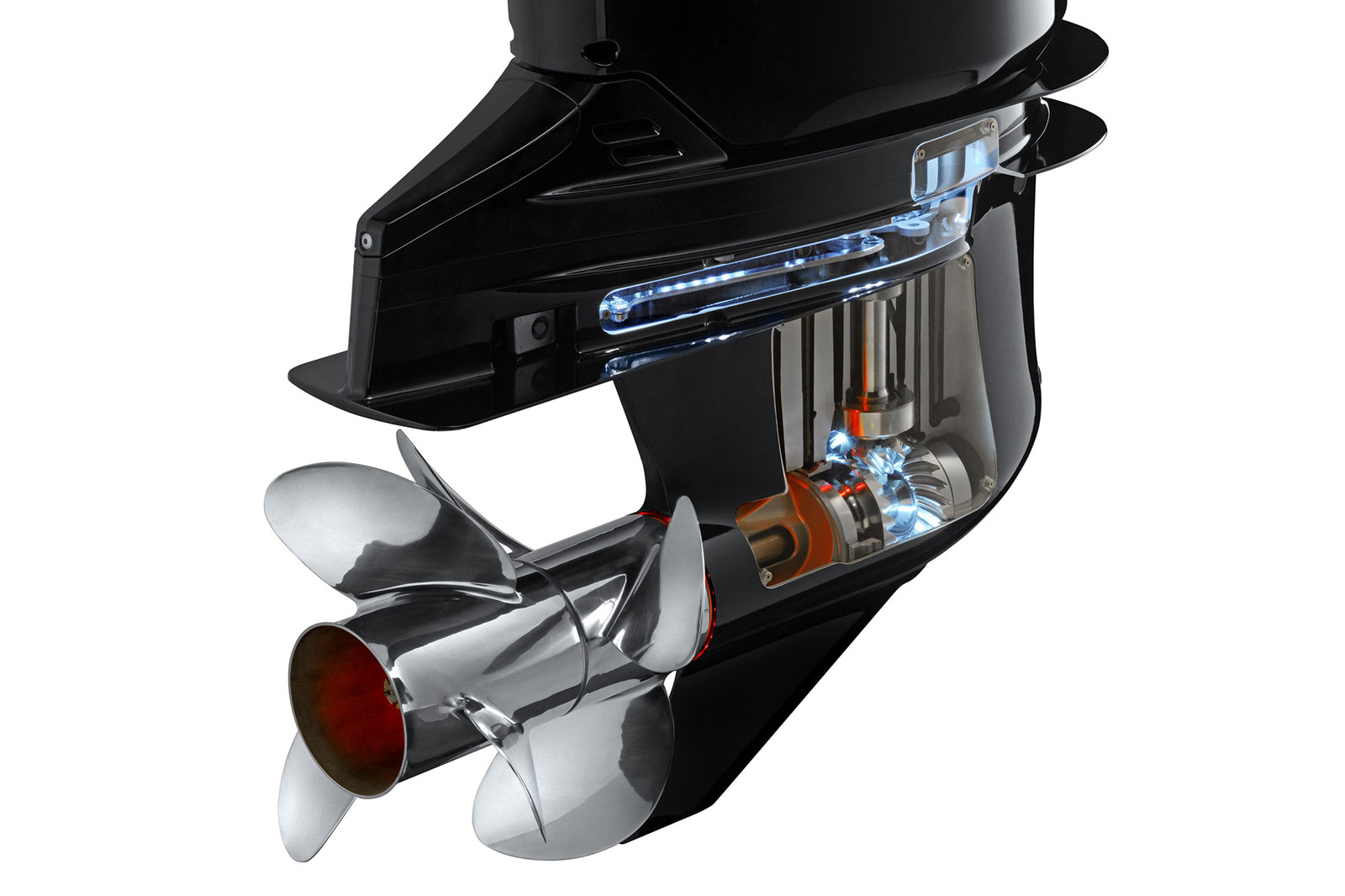
First, we looked at the traditional single propeller design. A single propeller creates forward thrust, to be sure, but also produces a significant amount of rotational energy as a byproduct. Was there a way we could convert this wasted energy into productive power and improve propeller efficiency?
Secondly, the leading edge of the gear case disrupts the flow of water over the propeller. More power and torque require stronger, larger gears to transfer power from the driveshaft to the propeller shaft.
This typically results in a larger gear case – and consequently, more disruption of the flow of water to the propeller. Could we design a lower unit that could house stronger gears and yet minimize the disruption of the flow of water to the propellers?
Suzuki engineers labored mightily through years of computer simulations, trial and error, and on-water testing, to significantly improve the way an outboard converts engine power into underwater thrust.
They have succeeded in this quest – and the result is a revolution in innovation.
| FEATURE.01 12.0:1 COMPRESSION RATIO Our solution to developing 80 horsepower per liter in a V6 350 horsepower engine was to increase the compression ratio to 12.0:1, the highest compression ratio ever for a production outboard engine. In order to make this work without knocking (a typical problem at this ratio), we developed systems to mix cooler air with well-atomized fuel to provide optimal conditions for complete, and controlled combustion. |
 |
 |
SUZUKI DUAL PROP SYSTEM |
|
SUZUKI DUAL LOUVER SYSTEM |
 |
|
|
DUAL INJECTOR Dual injectors deliver just the right amount of fuel at just the right time into the cylinder. This dual injector contributes to higher output and better fuel efficiency. |
|
OFFSET DRIVESHAFT |
 |
 |
2-STAGE GEAR REDUCTION |
|
DIRECT AIR INTAKE A new engine cover design provides the direct intake system with a smoother, cooler flow of air boosting engine operating efficiency. |
 |
| |
LEAN BURN |
|
SUZUKI PRECISION CONTROL |
 |
|
|
VARIABLE VALVE TIMING SYSTEM (VVT) Variable Valve Timing is used to vary intake timing with the camshaft to optimize timing for low to mid-range operation. This allows the engine to deliver maximum power output across its entire operating range producing greater low to mid-range torque for powerful acceleration. The entire process happens automatically leaving you to enjoy the power and performance. |
| SELF-ADJUSTING TIMING CHAIN The timing chain runs in an oil-bath, so it never needs lubricating, and is equipped with an automatic hydraulic tensioner, so it remains properly adjusted at all times. Simple, effective and maintenance-free. |
|
|
|
DUAL WATER INLET The engine’s cooling system relies on water supplied through low water intakes located on the lower unit. Utilizing this dual low water inlet configuration increases water flow into the lower unit, delivering greater cooling efficiency. Positioning the forward inlet by the gear case nose delivers a greater water supply, especially at high speeds. The second inlet is also positioned lower allowing the DF350A to operate in shallow water. |


SPECIFICATIONS
MODEL DF350A
RECOMMENDED TRANSOM HEIGHT mm (in.)
X : 635 (25)XX : 762 (30)
STARTING SYSTEM Electric
WEIGHT kg (Ibs.) *1
X : 330 (727)XX : 339 (747)
ENGINE TYPE V6 - 55° DOHC 24-Valve
Valve Train Drive Chain with Variable Valve Timing
FUEL DELIVERY SYSTEM Electronic Fuel Injection
NO. OF CYLINDERS 6
PISTON DISPLACEMENT ㎤ (cu.in.) 4,390 (267.9)
BORE × STROKE mm (in.) 98 (3.74) x 97 (3.82)
MAXIMUM OUTPUT kW (PS) 257.4 (350)
FULL THROTTLE OPERATING RANGE rpm 5,700 - 6,300
STEERING Remote
OIL PAN CAPACITY l (U.S./Imp. qt.) 8.0 (8.5)
IGNITION SYSTEM Fully-transistorized
ALTERNATOR 12V 54A
ENGINE MOUNTING Shear Mount
TRIM METHOD Power Trim and Tilt
GEAR RATIO 2.29:1
GEAR SHIFT F-N-R (Drive-by-Wire)
EXHAUST Through Prop Hub Exhaust
PROPELLER SELECTION (Pitch) *2
All propellers are the 3-blade type
FRONT: 3×15 1/2×19.5-31.5
REAR: 3×15 1/2×19.5-31.5